
Original price was: $393.30.$94.99Current price is: $94.99.
- Experience Quality, Shop with Us
- Quality that lasts, prices that don't.
- Where quality meets convenience.
- Get Quality, Get More

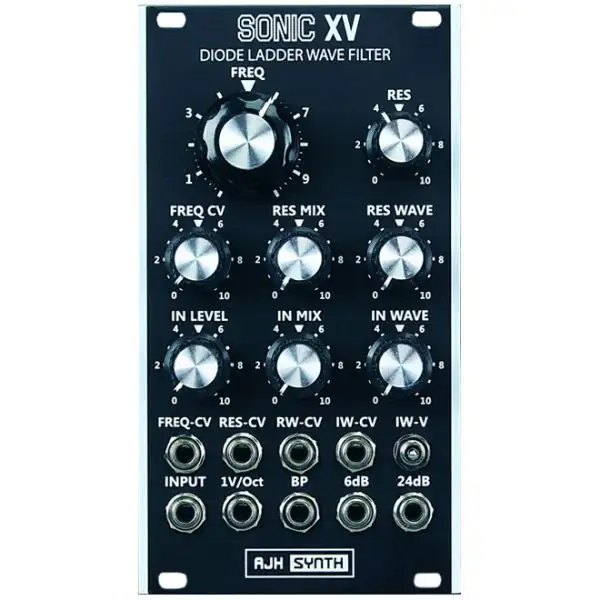
The AJH Synth Sonic XV Wave Filter is a four pole Diode Ladder Filter, featuring the circuitry and sound of the Musonics Sonic V synthesizer, which has a quite different character from transistor ladder filters. In addition to the regular 24 dB Low Pass output AJH have added a 6 dB Low Pass output and a Bandpass output, along with full voltage control of the resonance.
Two waveshapers have been added to hugely increase the sonic versatility of this module. There is a breakpoint based wavefolder on the input, with drive level that can be manually adjusted or voltage controlled. A bias control switch allows extra waveshape variations.
A second waveshaper is connected to the resonance circuit, which adds distortion and waveshaping to the resonance loop signal, again the drive can be adjusted manually or under full voltage control. A wet/dry mix control allows resonance waveshaping to be added from 0 to 100%.
These additions take the diode ladder filter core way beyond it’s original function, it becomes a “filter” module that can add harmonics and shape waveforms rather than simply filtering them. With four independent CV inputs very complex filtering and waveshaping sounds become possible.
The AJH Synth Sonic XV filter core is based on the diode ladder filter from the original Musonics Sonic V synthesizer dating back to the early 1970s. This particular diode ladder filter was originally developed by Eugene Zumchak (a former Moog employee) as a “work around” of the original patent (held by Dr Bob Moog) for the transistor ladder filter – the diode ladder was considered sufficiently different that it did not infringe the patent at the time. The diode ladder filter has quite a different character to its transistor ladder parent, largely because the individual filter poles are not fully buffered as they are in the transistor ladder variant.
The diode ladder filter topology used in the Sonic V is rather different to the better known diode filters from EMS and Roland, as the frequency cutoff control voltage is actually summed with the audio signal before being added to the top of the diode ladder string. The early Roland and EMS diode ladders designs followed the more usual practice of feeding the frequency control voltage into the bottom of the diode ladder string.
| Condition | New |
|---|---|
| Depth | 24, mm |
| Chassis | Module |
| Module Type | Eurorack |
| Module Slot Count | 14hp |
| Connector Type | 3.5, mm |
| Power Consumption | 70, mA, +12, V, /, 55, mA |
Be the first to review “Best Pirce ❤️ AJH Synth Sonic XV Wave Filter – Black ????”
Related products
Modular Synth Filters
Modular Synth Filters
Wholesale ⌛ Behringer System 55 923 Filters Eurorack Module ????
Modular Synth Filters
Best reviews of ???? Mosaic Low Pass Filter 1U Eurorack Module – White ❤️
Modular Synth Filters
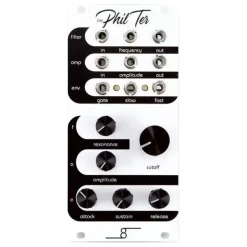
Discount ???? Cre8audio Mr. Phil Ter Eurorack VCA, Filter And Envelope Generator Module ????
Modular Synth Filters
Modular Synth Filters
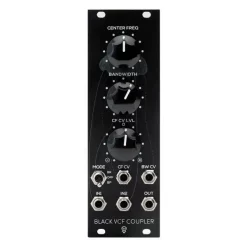
Hot Sale ⭐ Erica Synths Black Filter Coupler Eurorack Module ????

Modular Synth Filters
Modular Synth Filters
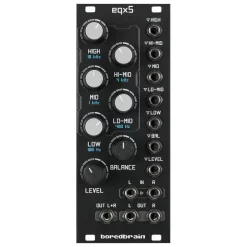
Promo ???? Boredbrain Eqx5 Voltage-Controlled Equalizer Module ⌛
Reviews
There are no reviews yet.