
Original price was: $450.00.$97.99Current price is: $97.99.
- Experience Quality, Shop with Us
- Quality that lasts, prices that don't.
- Where quality meets convenience.
- Get Quality, Get More

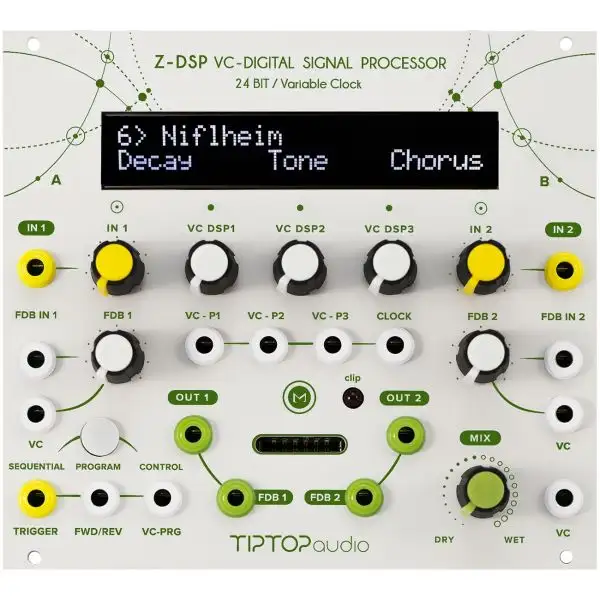
The Tiptop Audio Z-DSP MKII is a cartridge-based open source digital sound processing and effects generating platform for your modular synthesizer. Lush audio processing, greater stereo depth and a unique set of digital synthesis is what the Z-DSP is all about.
The Z-DSP has a stereo digital sound processor with 24-bit sampling, 15 kHz of bandwidth, voltage-controlled parameters of stereo feedback, program switching, DSP parameters, equal power crossfading dry/wet mixing, as well as sequential program control switching and a clear display – all in Eurorack format. A dedicated clocking input for the DSP chip does wonders to passing sound by bending the algorithms in an unexpected way, a hardware technique computer plugins can’t do and is unique to the Z-DSP.
In a recent update, the Z-DSP (NS) got an all new design of its analog circuitry, contributing to a lower noise signal path, clearer sound of the entire frequency range, lower distortion and better immunity to noise emitted by other modules sharing the same power supply. A new analog dry/wet circuit has been implemented to remove the 3 db gain drop when the mix knob passes through the center of the dial making the use of this function more practical in a live application. A reverse polarity protection has been added as well. The new front-panel matches Tiptop’s colorful design, and a single printed circuit board and surface mount technology improve reliability during production and use. The powerful Z-DSP engine remains the same as the original Z-DSP module and all cards are compatible across both versions.
An assortment of interchangeable cards, programmed by Tiptop Audio and specialists like Valhalla DSP, provide a wide range of boutique effects algorithms such as Halls of Valhalla, Time Fabric, Clocked Delays and Grain De Folie. Tiptop Audio also offers blank Z-DSP cartridges and a development tool called NumberZ for developers, students and power users who want to design their own effects and cards with the FV-1 DSP chip programing language. Blank cards can be loaded using programs that are freely available for non-commercial use and can be found in the modular community through online forums. With each card swap, the Z-DSP takes on new effect algorithms, changing like a digital chameleon and bringing colorful digital effects processing to your Eurorack setup.
The Z-DSP comes included with 2 cards: Halls of Valhalla and Dragonfly Delay MKII.
The Halls of Valhalla is a reverb cartridge for the Tiptop Audio Z-DSP. The cartridge contains 8 original reverb algorithms, custom designed for the Z-DSP and the Eurorack environment. Voltage control over reverb decay, tone, and modulation allows the user to create reverbs ranging from small rooms to large halls to near-infinite decays.
The Halls of Valhalla brings the artifacts of fixed point digital signal processing to the forefront, resulting in a thickness and warmth that evokes the classic digital gear of the 1970s through the early 1990s. The goal of the algorithms is not to evoke physical environments, but rather to create unreal spaces that range from subtle to bombastic, from light to dark, with a lushness that turns simple input sounds into rich orchestral washes. The Halls of Valhalla brings the Valhalla DSP aesthetics into the hardware world: Minimalist interface, Maximalist sound.
Dragonfly MKII is a set of eight voltage-controlled, time-based delay effects for the Z-DSP. MKII features advanced delay programs with added filters and additional taps spicing up the original set of Dragonfly programs.
With up to 1000ms of delay time and feedback control on each program, the Dragonfly MKII is perfect for deep, stereophonic, spacey washes of sound covering all delay effect duties within a modular and more.
The external feedback loop on the Z-DSP let you feedback through other modules like filters, VCAs or just about any other module to further process the Dragonfly repeats.
Hook up a Z3000 for a variable clock of the DSP processor chip to mess up the algorithm’s processing speed, shifting from clear digital repeats to grungy lo-fi warbles, this is where binary DSP bits meet up with the organic analog circuity of the Z-DSP.
- Mono in Stereo out L/R Tap: Two taps on a mono delay time
- Mono in Stereo out Lowpass + Feedback: Two delay taps with LPF in feedback
- Mono in Stereo out Highpass + Feedback: Two delay taps with HPF in feedback
- Mono in Stereo out Right Ratio: Selector for ratio of Right delay time to Left
- Mono in Stereo out Ping Pong: Two tap delay from Left to Right with LPF
- Stereo in Stereo out L/R Delay: Independent delay lines on Left and Right
- Stereo in Stereo out Highpass + Feedback: Two delay lines with HPF in feedback
- Stereo in Stereo out Lowpass + Feedback: Tow delay lines with LPF in feedback
| Condition | New |
|---|---|
| Chassis | Module |
| Module Type | Eurorack |
| Module Slot Count | 28hp |
| Connector Type | 3.5, mm |
| Power Consumption | 200, mA, +12, V, /, 87, mA, -12, V |
Be the first to review “Hot Sale ⌛ Tiptop Audio Z-DSP MKII ????”
Related products
Modular Synth Effects
Discount ???? Tiptop Audio Z5000 Multi Effect Module – Black ????
Modular Synth Effects
Modular Synth Effects

Modular Synth Effects
Flash Sale ???? Malekko 4-Channel Quad Gate Delay Module ????
Modular Synth Effects
Best Pirce ???? Strymon StarLab Time-Warped Reverberator Eurorack Module ⭐
Modular Synth Effects
Modular Synth Effects
Modular Synth Effects
Reviews
There are no reviews yet.